
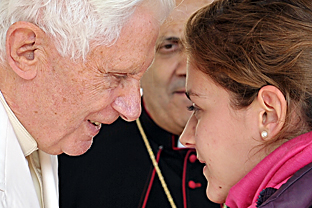
 Non solo "calcoli ed esperimenti" ma ricerca della "verità ultima", che è "la chiave della nostra felicità e della nostra libertà autentiche": è questo il metodo della vera conoscenza indicato dal Papa ai partecipanti all'incontro promosso dalla Specola Vaticana in occasione dell'Anno internazionale dell'astronomia, ricevuti in udienza venerdì mattina, 30 ottobre, nella Sala Clementina.
Your Eminence,
Ladies and Gentlemen,
I am pleased to greet this assembly of distinguished astronomers from throughout the world meeting in the Vatican for the celebration of the International Year of Astronomy, and I thank Cardinal Giovanni Lajolo for his kind words of introduction. This celebration, which marks the four hundredth anniversary of Galileo Galilei's first observations of the heavens by telescope, invites us to consider the immense progress of scientific knowledge in the modern age and, in a particular way, to turn our gaze anew to the heavens in a spirit of wonder, contemplation and commitment to the pursuit of truth, wherever it is to be found.
The International Year of Astronomy is meant not least to recapture for people throughout our world the extraordinary wonder and amazement which characterized the great age of discovery in the sixteenth century. I think, for example, of the exultation felt by the scientists of the Roman College who just a few steps from here carried out the observations and calculations which led to the worldwide adoption of the Gregorian calendar. Our own age, poised at the edge of perhaps even greater and more far-ranging scientific discoveries, would benefit from that same sense of awe and the desire to attain a truly humanistic synthesis of knowledge which inspired the fathers of modern science. Who can deny that responsibility for the future of humanity, and indeed respect for nature and the world around us, demand - today as much as ever - the careful observation, critical judgement, patience and discipline which are essential to the modern scientific method? At the same time, the great scientists of the age of discovery remind us also that true knowledge is always directed to wisdom, and, rather than restricting the eyes of the mind, it invites us to lift our gaze to the higher realm of the spirit.
Knowledge, in a word, must be understood and pursued in all its liberating breadth. It can certainly be reduced to calculation and experiment, yet if it aspires to be wisdom, capable of directing man in the light of his first beginnings and his final ends, it must be committed to the pursuit of that ultimate truth which, while ever beyond our complete grasp, is nonetheless the key to our authentic happiness and freedom (cf. Jn 8: 32), the measure of our true humanity, and the criterion for a just relationship with the physical world and with our brothers and sisters in the great human family.
Dear friends, modern cosmology has shown us that neither we, nor the earth we stand on, is the centre of our universe, composed of billions of galaxies, each of them with myriads of stars and planets. Yet, as we seek to respond to the challenge of this Year - to lift up our eyes to the heavens in order to rediscover our place in the universe - how can we not be caught up in the marvel expressed by the Psalmist so long ago? Contemplating the starry sky, he cried out with wonder to the Lord: "When I see your heavens, the work of your fingers, the moon and the stars which you set in place, what is man that you should be mindful of him, or the son of man, that you should care for him?" (Ps 8: 4-5). It is my hope that the wonder and exaltation which are meant to be the fruits of this International Year of Astronomy will lead beyond the contemplation of the marvels of creation to the contemplation of the Creator, and of that Love which is the underlying motive of his creation - the Love which, in the words of Dante Alighieri, "moves the sun and the other stars" (Paradiso xxxiii, 145). Revelation tells us that, in the fullness of time, the Word through whom all things were made came to dwell among us. In Christ, the new Adam, we acknowledge the true centre of the universe and all history, and in him, the incarnate Logos, we see the fullest measure of our grandeur as human beings, endowed with reason and called to an eternal destiny.
With these reflections, dear friends, I greet all of you with respect and esteem, and I offer prayerful good wishes for your research and teaching. Upon you, your families and dear ones I cordially invoke Almighty God's blessings of wisdom, joy, and peace.
Ecco una nostra traduzione italiana del discorso del Pontefice.
 Eminenza,
Signore e Signori,
sono lieto di salutare quest'assemblea d'insigni astronomi provenienti da tutto il mondo, che si incontrano in Vaticano per la celebrazione dell'Anno Internazionale dell'Astronomia, e ringrazio il Cardinale Giovanni Lajolo per le cordiali parole di introduzione. Questa celebrazione, che segna il quattrocentesimo anniversario delle prime osservazioni dei cieli da parte di Galileo Galilei con il telescopio, ci invita a considerare il progresso immenso della conoscenza scientifica nell'età moderna e, in modo particolare, a volgere il nostro sguardo al cielo con uno spirito di meraviglia, contemplazione e impegno per la ricerca della verità, ovunque essa debba essere trovata.
Il vostro incontro coincide anche con l'inaugurazione dei nuovi locali della Specola Vaticana a Castel Gandolfo. Come sapete, la storia della Specola è legata in modo molto concreto alla figura di Galileo, alle controversie intorno alle sue ricerche nonché al tentativo della Chiesa di ottenere una comprensione corretta e feconda del rapporto fra scienza e religione. Colgo questa occasione per esprimere gratitudine non solo per gli studi accurati che hanno chiarito il preciso contesto storico della condanna di Galileo, ma anche per gli sforzi di tutti coloro che sono impegnati nel dialogo e nella riflessione costanti sulla complementarità della fede e della ragione al servizio di una comprensione integrale dell'uomo e del suo posto nell'universo. Sono particolarmente grato al personale della Specola nonché agli amici e ai benefattori della Fondazione della Specola Vaticana per i loro sforzi volti a promuovere la ricerca, opportunità pedagogiche e il dialogo fra la Chiesa e il mondo scientifico.
L'Anno Internazionale dell'Astronomia intende, non da ultimo, catturare nuovamente per le persone di tutto il mondo la meraviglia e lo stupore straordinari che hanno caratterizzato la grande età delle scoperte nel sedicesimo secolo. Penso, per esempio, all'esultanza degli scienziati del Collegio Romano che, proprio a pochi passi da qui, fecero osservazioni e calcoli che portarono all'adozione mondiale del calendario gregoriano. La nostra epoca, che è sull'orlo di scoperte scientifiche forse ancor più grandi e di più vasta portata, trarrebbe beneficio da quello stesso senso di ammirata soggezione e dal desiderio di ottenere una sintesi veramente umanistica della conoscenza che ha ispirato i padri della scienza moderna. Chi può negare che la responsabilità del futuro dell'umanità, e, di fatto, il rispetto per la natura e per il mondo che ci circonda, richiedano, oggi più che mai, l'attenta osservazione, il giudizio critico, la pazienza e la disciplina che sono essenziali per il metodo scientifico moderno? Nello stesso tempo, i grandi scienziati dell'età delle scoperte ci ricordano anche che la conoscenza autentica è sempre rivolta alla sapienza, e, invece di restringere gli occhi della mente, ci invita ad alzare lo sguardo verso un più elevato regno dello spirito.
In breve, la conoscenza deve essere compresa e perseguita in tutta la sua ampiezza liberatrice. Essa si può certamente ridurre a calcoli e a esperimenti, ma, se aspira a essere sapienza, capace di orientare l'uomo alla luce dei suoi primi inizi e della sua conclusione finale, si deve impegnare nella ricerca della verità ultima che, pur essendo sempre al di là della nostra completa portata, è, nondimeno, la chiave della nostra felicità e della nostra libertà autentiche (cfr Gv 8, 32), la misura della nostra vera umanità e il criterio per un rapporto giusto con il mondo fisico e con i nostri fratelli e le nostre sorelle nella più grande famiglia umana.
Cari amici, la cosmologia moderna ci ha mostrato che né noi né la terra su cui viviamo siamo il centro del nostro universo, composto da miliardi di galassie, ognuna delle quali con miriadi di stelle e pianeti. Tuttavia, mentre cerchiamo di rispondere alla sfida di quest'Anno, di alzare gli occhi al cielo per riscoprire il nostro posto nell'universo, in che modo possiamo essere catturati dalla meraviglia espressa dal Salmista così tanto tempo fa? Infatti, contemplando il cielo stellato egli gridò con stupore a Dio: "Quando vedo i tuoi cieli, opera delle tue dita, la luna e le stelle che hai fissato, che cos'è mai l'uomo perché di lui ti ricordi, il figlio dell'uomo, perché te ne curi?" (Sal 8, 4-5). Spero che lo stupore e l'esultanza che intendono essere i frutti di questo Anno Internazionale dell'Astronomia condurranno oltre la contemplazione delle meraviglie del creato fino alla contemplazione del Creatore e di quell'Amore che è il motivo che sottende la sua creazione, l'Amore che, con le parole di Dante Alighieri, "Move il sole e l'altre stelle" (Paradiso xxxiii, 145). L'Apocalisse ci dice che, nella pienezza dei tempi, la Parola attraverso la quale tutte le cose sono state fatte è venuta a dimorare in mezzo a noi. In Cristo, il nuovo Adamo, riconosciamo il centro autentico dell'universo e di tutta la storia, e in Lui, il Logos incarnato, vediamo la misura colma della nostra grandeur di esseri umani, dotati di ragione e chiamati a un destino eterno.
Cari amici, con queste riflessioni vi saluto tutti con rispetto e stima e offro i miei buoni auspici oranti per la vostra ricerca e per il vostro insegnamento. Su di voi, sulle vostre famiglie e sui vostri cari invoco cordialmente le benedizioni di sapienza, gioia e pace di Dio Onnipotente.
(©L'Osservatore Romano - 31 ottobre 2009)