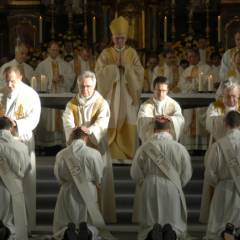
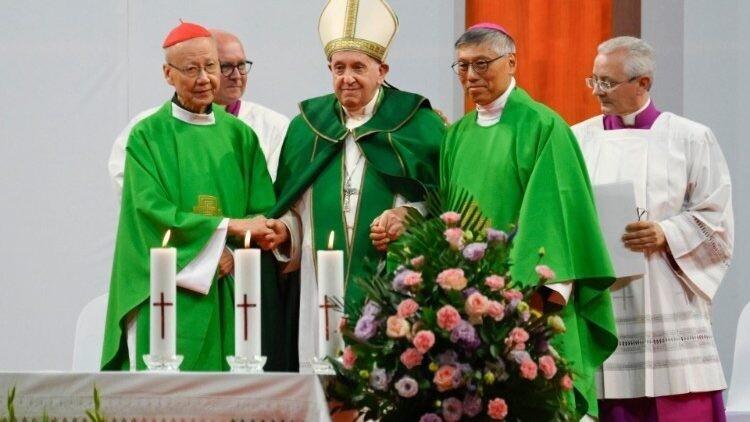
 Questo pomeriggio, lasciata la Prefettura Apostolica, il Santo Padre Francesco si è trasferito in auto alla Steppe Arena per la Santa Messa.
Al Suo arrivo, dopo aver effettuato il cambio di vettura, il Papa ha compiuto alcuni giri in golf car tra gli oltre 2000 fedeli presenti e alle ore 16.00 (10.00 ora di Roma) ha presieduto la Celebrazione Eucaristica in lingua inglese, nella XXII Domenica del Tempo Ordinario.
Nel corso della Santa Messa, dopo la proclamazione del Vangelo, il Santo Padre ha pronunciato l’omelia.
Al termine, dopo l’indirizzo di omaggio del Prefetto Apostolico di Ulaanbaatar, Em.mo Card. Giorgio Marengo, I.M.C., e prima della benedizione finale, il Papa ha rivolto ai fedeli e ai pellegrini presenti un saluto finale e alcune parole di ringraziamento. Quindi è rientrato in auto alla Prefettura Apostolica.
Pubblichiamo di seguito l’omelia e il saluto finale che il Santo Padre ha pronunciato nel corso della Santa Messa:
Con le parole del Salmo abbiamo pregato: «O Dio, […] ha sete di te l’anima mia, desidera te la mia carne in terra arida, assetata, senz’acqua» (Sal 63,2). Questa stupenda invocazione accompagna il viaggio della nostra vita, in mezzo ai deserti che siamo chiamati ad attraversare. E proprio in questa terra arida ci raggiunge una buona notizia: nel nostro cammino non siamo soli; le nostre aridità non hanno il potere di rendere sterile per sempre la nostra vita; il grido della nostra sete non rimane inascoltato. Dio Padre ha mandato il suo Figlio a donarci l’acqua viva dello Spirito Santo per dissetare la nostra anima (cfr Gv 4,10). E Gesù – lo abbiamo appena ascoltato nel Vangelo – ci mostra la via per essere dissetati: è la via dell’amore, che Lui ha percorso fino in fondo, fino alla croce, e sulla quale ci chiama a seguirlo “perdendo la vita per ritrovarla” nuova (cfr Mt 16,24-25).
Soffermiamoci insieme su questi due aspetti: la sete che ci abita e l’amore che ci disseta.
Anzitutto, siamo chiamati a riconoscere la sete che ci abita. Il salmista grida a Dio la propria arsura perché la sua vita assomiglia a un deserto. Le sue parole hanno una risonanza particolare in una terra come la Mongolia: un territorio immenso, ricco di storia, una terra piena di cultura, ma anche segnato dall’aridità della steppa e del deserto. Tanti di voi sono abituati alla bellezza e alla fatica del camminare, azione che richiama un aspetto essenziale della spiritualità biblica, rappresentato dalla figura di Abramo e, più in generale, proprio del popolo d’Israele e di ogni discepolo del Signore: tutti, tutti noi infatti, siamo “nomadi di Dio”, pellegrini alla ricerca della felicità, viandanti assetati d’amore. Il deserto evocato dal salmista si riferisce, dunque, alla nostra vita: siamo noi quella terra arida che ha sete di un’acqua limpida, di un’acqua che disseta in profondità; è il nostro cuore che desidera scoprire il segreto della vera gioia, quella che anche in mezzo alle aridità esistenziali, può accompagnarci e sostenerci. Sì, ci portiamo dentro una sete inestinguibile di felicità; siamo alla ricerca di un significato e una direzione della nostra vita, di una motivazione per le attività che portiamo avanti ogni giorno; e soprattutto siamo assetati di amore, perché è solo l’amore che ci appaga davvero, che ci fa stare bene – l’amore ci fa stare bene –, che ci apre alla fiducia facendoci gustare la bellezza della vita. Cari fratelli e sorelle, la fede cristiana risponde a questa sete; la prende sul serio; non la rimuove, non cerca di placarla con palliativi o surrogati: no! Perché in questa sete c’è il nostro grande mistero: essa ci apre al Dio vivente, al Dio Amore che ci viene incontro per farci figli suoi e fratelli e sorelle tra di noi.
E veniamo così al secondo aspetto: l’amore che ci disseta. Primo era la nostra sete, esistenziale, profonda, e adesso pensiamo all’amore che ci disseta. Questo è il contenuto della fede cristiana: Dio, che è amore, nel suo Figlio Gesù si è fatto vicino a te, a me, a tutti noi, desidera condividere la tua vita, le tue fatiche, i tuoi sogni, la tua sete di felicità. È vero, a volte ci sentiamo come una terra deserta, arida e senz’acqua, ma è altrettanto vero che Dio si prende cura di noi e ci offre l’acqua limpida e dissetante, l’acqua viva dello Spirito che sgorgando in noi ci rinnova liberandoci dal pericolo della siccità. Quest’acqua ce la dona Gesù. Come afferma Sant’Agostino, «se ci riconosceremo nell’assetato, ci riconosceremo anche nel dissetato» (Sul Salmo 62, 3). Infatti, se tante volte nella nostra vita sperimentiamo il deserto, la solitudine, la fatica, la sterilità, non dobbiamo però dimenticare questo: «Affinché non veniamo meno in questo deserto – aggiunge Agostino – Dio ci irrora con la rugiada della sua Parola […]. Ci fa, sì, provare la sete ma poi viene ad appagarla. […] Dio ha avuto misericordia di noi e ha aperto per noi una via nel deserto: il Signore nostro Gesù Cristo», e questa è la via nel deserto della vita. «E ci ha procurato una consolazione nel deserto: i predicatori della sua Parola. Ci ha offerto dell’acqua nel deserto, ricolmando di Spirito Santo i suoi predicatori affinché si formasse in essi una fonte di acqua che sale fino alla vita eterna» (ibid., 3.8). Queste parole, carissimi, richiamano la vostra storia: nei deserti della vita e nella fatica di essere una comunità piccola, il Signore non vi fa mancare l’acqua della sua Parola, specialmente attraverso i predicatori e i missionari che, unti dallo Spirito Santo, ne seminano la bellezza. E la Parola sempre, sempre ci riporta all’essenziale, all’essenziale della fede: lasciarsi amare da Dio per fare della nostra vita un’offerta d’amore. Perché solo l’amore ci disseta veramente. Non dimentichiamo: solo l’amore disseta veramente.
È ciò che Gesù, nel Vangelo di oggi, dice con tono forte all’apostolo Pietro. Questi non accetta il fatto che Gesù dovrà soffrire, essere accusato dai capi del popolo, attraversare la passione e poi morire sulla croce. Pietro reagisce, Pietro protesta, vorrebbe convincere Gesù che si sbaglia, perché secondo lui – e così spesso pensiamo anche noi – il Messia non può finire sconfitto, assolutamente non può morire crocifisso, come un malfattore abbandonato da Dio. Ma il Signore rimprovera Pietro, perché questo suo modo di pensare è “secondo il mondo”, dice il Signore, e non secondo Dio (cfr Mt 16,21-23). Se pensiamo che a dissetare le arsure della nostra vita bastino il successo, il potere, le cose materiali, questa è una mentalità mondana, che non porta a nulla di buono e, anzi, ci lascia più aridi di prima. Gesù invece ci indica la via: «Se qualcuno vuole venire dietro a me, rinneghi sé stesso, prenda la sua croce e mi segua. Perché chi vuole salvare la propria vita, la perderà; ma chi perderà la propria vita per causa mia, la troverà» (Mt 16,24-25).
Fratelli, sorelle, la via migliore di tutte è questa: abbracciare la croce di Cristo. Al cuore del cristianesimo c’è questa notizia sconvolgente, notizia straordinaria: quando perdi la tua vita, quando la offri con generosità in servizio, quando la rischi impegnandola nell’amore, quando ne fai un dono gratuito per gli altri, allora essa ti ritorna in abbondanza, riversa dentro di te una gioia che non passa, una pace del cuore, una forza interiore che ti sostiene. E abbiamo bisogno di pace interiore.
Questa è la verità che Gesù ci invita a scoprire, che Gesù vuole svelare a voi tutti, a questa terra di Mongolia: non serve essere grandi, ricchi o potenti per essere felici: no! Solo l’amore ci disseta il cuore, solo l’amore guarisce le nostre ferite, solo l’amore ci dà la vera gioia. E questa è la via che Gesù ci ha insegnato e ha aperto per noi.
Anche noi, fratelli e sorelle, allora ascoltiamo la parola che il Signore dice a Pietro: «Va’ dietro a me» (Mt 16,23), vale a dire: diventa mio discepolo, fai la stessa strada che faccio io e non pensare più secondo il mondo. Allora, con la grazia di Cristo e dello Spirito Santo, potremo camminare sulla via dell’amore. Anche quando amare significa rinnegare sé stessi, lottare contro gli egoismi personali e mondani, correre il rischio di vivere la fraternità. Perché se è vero che tutto ciò costa fatica e sacrificio e a volte significa dover salire sulla croce, è ancora più vero che quando perdiamo la vita per il Vangelo, il Signore ce la dona in abbondanza, piena di amore e di gioia, per l’eternità.
With the words of the Responsorial Psalm, we prayed: “O God... my soul thirsts for you; my flesh faints for you, as in a dry and weary land where there is no water” (Ps 63:2). This magnificent plea accompanies our journey through life, amid all the deserts we are called to traverse. It is precisely in those deserts that we hear the good news that we are not alone in our journey; those times of dryness cannot render our lives barren forever; our cry of thirst does not go unheard. God the Father has sent his Son to give us the living water of the Holy Spirit to satisfy our souls (cf. Jn 4:10). Jesus, as we heard in the Gospel, shows us the way to quench our thirst. It is the way of love, which he followed even to the cross, and on which he calls us to follow him, losing our lives in order to find them (cf. Mt 16:24-25).
Let us reflect together on these two things: the thirst within us, and the love that quenches that thirst.
First, we are called to acknowledge the thirst within us. The Psalmist cries out to God in his aridity, for his life has become like a desert. His words have a particular resonance in a land like Mongolia: immense, rich in history and culture, yet a land also marked by the aridity of the steppes and the desert. Many of you know both the satisfaction and the fatigue of journeying, which evokes a fundamental aspect of biblical spirituality represented by Abraham and, in a broader sense, by the people of Israel and indeed every disciple of the Lord. For all of us are “God’s nomads”, pilgrims in search of happiness, wayfarers thirsting for love. The desert of which the Psalmist speaks, then, is our life. We are that dry land thirsting for fresh water, water that can slake our deepest thirst. Our hearts long to discover the secret of true joy, a joy that even in the midst of existential aridity, can accompany and sustain us. Deep within us, we have an insatiable thirst for happiness; we seek meaning and direction in our lives, a reason for all that we do each day. More than anything, we thirst for love, for only love can truly satisfy us, bring us fulfilment; only love can make us happy, inspire inner assurance and allow us to savour the beauty of life. Dear brothers and sisters, the Christian faith is the answer to this thirst; it takes it seriously, without dismissing it or trying to replace it with tranquilizers or surrogates. For in this thirst lies the great mystery of our humanity: it opens our hearts to the living God, the God of love, who comes to meet us and to make us his children, brothers and sisters to one another.
This brings us to the second thing: the love that quenches our thirst. First was our deep, existential thirst, and now we reflect on the love that quenches our thirst. This is the heart of the Christian faith: God, who is Love, has drawn near to you, to me, to everyone, in his Son Jesus, and wants to share in your life, your work, your dreams and your thirst for happiness. It is true that, at times, we feel like a “dry and weary land where there is no water”, yet it is equally true that God cares for us and offers us clear, refreshing water, the living water of the Spirit, springing up within us to renew us and free us from the risk of drought. Jesus gives us that water. As Saint Augustine tells us, “…if we recognize ourselves in those who thirst, we can also recognize ourselves in those who quench that thirst” (On the Psalms, 63:1). Indeed, if in this life we often experience the desert with loneliness, fatigue and emptiness, we should also remember, with Augustine, that, “lest we grow faint in this desert, God refreshes us with the dew of his word… True, he makes us feel thirst, but then comes to satisfy that thirst… God has been merciful to us; he has opened for us a highway in the desert: our Lord Jesus Christ”. And that is the path through the desert of our lives. “He has offered us a source of consolation in that desert: the preachers of his word. He has offered us water in that desert, by filling those preachers with the Holy Spirit, so as to create, in them, a fount of water springing up to life everlasting” (ibid., 1, 6). These words, dear friends, speak to you of your own history. Amid the deserts of life and in the difficulties associated with being a small community, the Lord has ensured that you not lack the water of his word, thanks especially to the preachers and missionaries who, anointed by the Holy Spirit, sow among you the seeds of its beauty. That word always brings us back to what is essential, to the very heart of our faith: allowing ourselves to be loved by God and in turn to make our lives an offering of love. For love alone truly quenches our thirst. Let us never forget: love alone truly quenches our thirst.
That is precisely what Jesus tells the apostle Peter in today’s Gospel. Peter cannot accept the fact that Jesus must suffer, be charged by the leaders of the people, undergo his passion and then die on the cross. Peter reacts, he protests, he tries to convince Jesus that he is wrong, because, in Peter’s mind – and we too often have the same idea – the Messiah cannot possibly end in failure, dying on a cross like a criminal forsaken by God. The Lord then rebukes Peter because he thinks “as the world does”, and not as God does (cf. Mt 16:21-23). If we think that success, power, or material things suffice to satisfy the thirst in our lives, then we are thinking as the world does. That kind of worldliness leads nowhere; indeed, it leaves us thirstier than before. Jesus instead shows us the way: “If any want to become my followers, let them deny themselves and take up their cross and follow me. For those who want to save their life will lose it, and those who lose their life for my sake will find it” (Mt 16:24-25).
This, dear brothers and sisters, is surely the best way: to embrace the cross of Christ. At the heart of Christianity is an amazing and extraordinary message. If you lose your life, if you make it a generous offering in service, if you risk it by choosing to love, if you make it a free gift for others, then it will return to you in abundance, and you will be overwhelmed by endless joy, peace of heart, and inner strength and support; and we need inner peace.
This is the truth that Jesus wants us to discover, the truth he wants to reveal to all of you and to this land of Mongolia. You need not be famous, rich or powerful to be happy. No! Only love satisfies our hearts’ thirst, only love heals our wounds, only love brings us true joy. This is the way that Jesus taught us; this is the path that he opened up before us.
May we too, dear brothers and sisters, heed what the Lord said to Peter in response: “Get behind me” (Mt 16:23). In other words, be my disciple, walk in my footsteps and stop thinking as the world does. If we do this, we will be able, with the grace of Christ and the Holy Spirit, to journey along the path of love. Even when love calls for denying ourselves, combatting our personal and worldly forms of selfishness, and taking the risk of living a life of genuine fraternity. For while it is true that all these things entail effort and sacrifice, and sometimes taking up the cross, it is even more true that, when we lose our lives for the sake of the Gospel, the Lord gives them back to us abundantly, in the fullness of love and joy for all eternity.
Questi due fratelli vescovi, l’emerito di Hong Kong e l’attuale vescovo di Hong Kong: io vorrei approfittare della loro presenza per inviare un caloroso saluto al nobile popolo cinese. A tutto il popolo auguro il meglio, e andare avanti, progredire sempre! E ai cattolici cinesi chiedo di essere buoni cristiani e buoni cittadini. A tutti. Grazie
Grazie, Eminenza, per le sue parole, e grazie per il vostro dono! Lei ha detto che in questi giorni avete toccato con mano quanto mi sia caro il Popolo di Dio che è in Mongolia. È vero, sono partito per questo pellegrinaggio con molta attesa, con il desiderio di incontrarvi e di conoscervi, e ora ringrazio Dio per voi perché, attraverso di voi, Egli ama compiere grandi cose nella piccolezza. Grazie, perché siete buoni cristiani e onesti cittadini. Andate avanti, con mitezza e senza paura, avvertendo la vicinanza e l’incoraggiamento di tutta la Chiesa, e soprattutto lo sguardo tenero del Signore, che non dimentica nessuno e guarda con amore ciascuno dei suoi figli.
Saluto i fratelli Vescovi, i sacerdoti, i consacrati e le consacrate, e tutti gli amici venuti qui da diversi Paesi, in particolare da varie regioni dell’immenso continente asiatico, nel quale sono onorato di trovarmi e che abbraccio con grande affetto. Esprimo particolare gratitudine a quanti aiutano la Chiesa locale, sostenendola spiritualmente e materialmente.
In questi giorni significative delegazioni del Governo hanno presenziato ad ogni evento: ringrazio il Signor Presidente e le Autorità per l’accoglienza e per la cordialità, così come per tutti i preparativi svolti. Ho toccato con mano la tradizionale cordialità: grazie!
Saluto poi di cuore i fratelli e le sorelle di altre Confessioni cristiane e religioni: continuiamo a crescere insieme nella fraternità, come semi di pace in un mondo tristemente funestato da troppe guerre e conflitti.
E il mio “grazie” sentito va a tutti coloro che qui hanno lavorato, tanto e da tanto tempo, per rendere bello, per rendere possibile questo viaggio, e a quanti lo hanno preparato con la preghiera.
Eminenza, ci ha ricordato che la parola “grazie” in lingua mongola deriva dal verbo “rallegrarsi”. Il mio grazie si accorda con questa meravigliosa intuizione della lingua locale, perché è pieno di gioia. È un grazie grande a te, popolo mongolo, per il dono dell’amicizia che ho ricevuto in questi giorni, per la tua capacità genuina di apprezzare anche gli aspetti più semplici della vita, di custodire con sapienza le relazioni e le tradizioni, di coltivare la quotidianità con cura e attenzione.
La Messa è azione di grazie, “Eucaristia”. Celebrarla in questa terra mi ha fatto ricordare la preghiera del padre gesuita Pierre Teilhard de Chardin, elevata a Dio esattamente 100 anni fa, nel deserto di Ordos, non molto lontano da qui. Dice così: «Mi prostro, o Signore, dinanzi alla tua Presenza nell’Universo diventato ardente e, sotto le sembianze di tutto ciò che incontrerò, e di tutto ciò che mi accadrà, e di tutto ciò che realizzerò in questo giorno, io Ti desidero, io Ti attendo». Padre Teilhard era impegnato in ricerche geologiche. Desiderava ardentemente celebrare la Santa Messa, ma non aveva con sé né pane né vino. Ecco, allora, che compose la sua “Messa sul mondo”, esprimendo così la sua offerta: «Ricevi, o Signore, questa Ostia totale che la Creazione, mossa dalla tua attrazione, presenta a Te nell’alba nuova». E una preghiera simile era già nata in lui mentre si trovava al fronte durante la Prima guerra mondiale, dove operava come barelliere. Questo sacerdote, spesso incompreso, aveva intuito che «l’Eucaristia è sempre celebrata, in un certo senso – in un certo senso –, sull’altare del mondo» ed è «il centro vitale dell’universo, il centro traboccante di amore e di vita inesauribile» (Enc. Laudato si’, 236), anche in un tempo come il nostro di tensioni e di guerre. Preghiamo, dunque, oggi con le parole di padre Teilhard: «Verbo sfavillante, Potenza ardente, o Tu che plasmi il molteplice per infondergli la tua Vita, abbassa su di noi, Te ne supplico, le tue Mani potenti, le tue Mani premurose, le tue Mani onnipresenti».
Fratelli e sorelle della Mongolia, grazie per la vostra testimonianza, bayarlalaa! [grazie!]. Dio vi benedica. Siete nel mio cuore e nel mio cuore rimarrete. Ricordatemi, per favore, nelle vostre preghiere e nei vostri pensieri. Grazie.
I would like to take this opportunity, in the presence of these two brother bishops – the Emeritus of Hong Kong and the current Bishop of Hong Kong – to send a heartfelt greeting to the noble Chinese people. I send my good wishes to them all: always move forward, always advance! And to Chinese Catholics: I ask you to be good Christians and good citizens. To all of you, thank you.
Thank you, Your Eminence, for your kind words, and thank you for your gift! You mentioned that in these days you could feel how dear the people of God in Mongolia are to my heart. That is true: I embarked on this pilgrimage with great anticipation, with the desire to meet all of you and to get to know you. Now I thank God for you, since, through you, he loves to use what is little to achieve great things. Thank you, because you are good Christians and honest citizens. Go forward, gently and without fear, conscious of the closeness and the encouragement of the entire Church, and above all the tender gaze of the Lord, who forgets no one and looks with love upon each of his children.
I greet my brother bishops, the priests, the consecrated men and women, and all the friends who have come here from different countries, particularly from various regions of the immense continent of Asia, in which I am honoured to find myself. I embrace all of you with great affection. I am especially grateful to all those who assisted the local Church with their spiritual and material support.
In these days, important Government delegations have been present at every event. I thank the President and the Authorities for their welcome and hospitality, and for all of the preparations that were made. I felt at first hand your traditional friendliness; thank you!
I also offer a warm greeting to our brothers and sisters of other Christian confessions and other religions. May we continue to grow closer in fraternity, as seeds of peace in a world tragically devastated by all too many wars and conflicts.
My heartfelt thanks likewise go to all those who have worked, so hard and for such a long time, to make my Journey possible and successful, and to all those who prepared for it by their prayers.
Your Eminence, you reminded us that in the Mongolian language the word for “Thank you” comes from the verb “to rejoice”. My own “Thank you” dovetails perfectly with this marvellous insight of the local language, for it is full of joy. It is a great “Thank you” to the Mongolian people, for the gift of friendship that I received in these days, for your genuine capacity to value even the most simple aspects of life, to wisely preserve relationships and traditions, and to cultivate daily life with care and attention.
The Mass is itself a way of giving thanks: “Eucharistía”. To celebrate Mass in this land brought to my mind the prayer that the Jesuit Father Pierre Teilhard de Chardin offered to God exactly a hundred years ago, in the desert of Ordos, not far from here. He prayed: “My God, I prostrate myself before your presence in the universe that has now become living flame: beneath the lineaments of all that I shall encounter this day, all that happens to me, all that I achieve, it is you I desire, you I await”. Father Teilhard de Chardin was engaged in geological research. He fervently desired to celebrate Holy Mass, but lacked bread and wine. So he composed his “Mass on the World”, expressing his oblation in these words: “Receive, O Lord, this all-embracing host, which your whole creation, moved by your magnetism, offers you at the dawn of this new day”. A similar prayer had already taken shape in him when he served as a stretcher-bearer on the front lines during the First World War. This priest, often misunderstood, had intuited that “the Eucharist is always in some way celebrated on the altar of the world” and is “the living centre of the universe, the overflowing core of love and of inexhaustible life” (Laudato Sì, 236), even in times like our own, marked by conflicts and wars. Let us pray this day, then, in the words of Father Teilhard de Chardin: “Radiant Word, blazing Power, you who mould the manifold so as to breathe life into it, I pray you, lay on us those your hands – powerful, considerate, omnipresent”.
Dear brothers and sisters of Mongolia, thank you for your witness. Bayarlalaa! [Thank you!]. May God bless you. You are in my heart, and in my heart you will remain. Remember me, please, in your prayers and in your thoughts. Thank you.
© http://press.vatican.va/content/salastampa/it/bollettino.html - 3 settembre 2023